

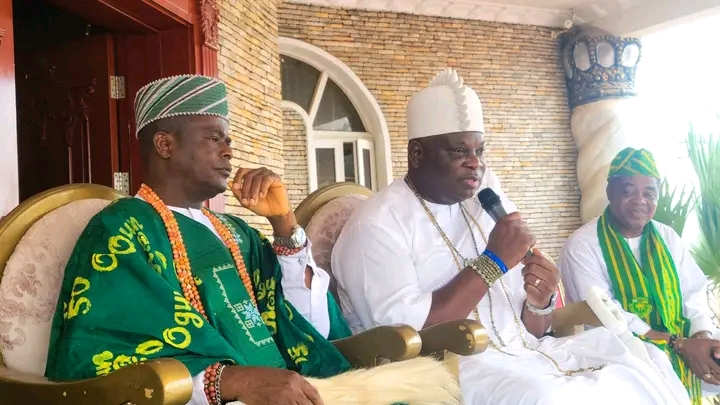
History often turns quietly—behind palace doors, away from microphones, and in moments when custodians of tradition choose to speak frankly about the future. Such was the weight and symbolism of the meeting held on Sunday, 8th February 2026, when Oba Kehinde Gbadewole Olugbenle, the Olu of Ilaro, Paramount Ruler of Yewaland and Chairman of the Ogun State Council of Obas, received Oba Prof Abdulkadir Adeyemi Obalanlege, the Olota of Ota, in a private and deeply strategic engagement.
This was not a courtesy visit. It was a deliberate convergence of history, grievance, hope, and political calculation—anchored on what has now become known across the state as the Ogun West Agenda.
Since the creation of Ogun State in 1976, political power has rotated largely between Ogun Central and Ogun East. From military-era administrators to civilian governors in the Fourth Republic, the historical archive of the state reveals a consistent pattern: Ogun West has remained the backbone without being the driver. The zone has contributed immensely—industrially, economically, culturally, and demographically—yet has never produced a governor in the state’s nearly five decades of existence.
Yewaland and Aworiland, which together form the core of Ogun West, have been pivotal to Ogun’s economic rise. From the industrial corridors of Ota to the agricultural and border advantages of Ilaro and its environs, Ogun West has long functioned as the state’s economic engine. However, political power has eluded it, often postponed by elite bargains, divided interests, and a lack of unified front.
It is against this backdrop that the meeting between Oba Olugbenle and the Olota of Ota assumes historic importance. As royal fathers who command not only cultural authority but also moral legitimacy across their domains, their decision to engage directly on the Ogun West question signals a turning point.
Oba Olugbenle, widely respected for his calm intellect, deep historical awareness, and bridge-building disposition, has consistently spoken about justice, balance, and inclusion within Ogun State. As Chairman of the Ogun State Council of Obas, his voice carries weight beyond Yewaland. The Olota of Ota, a seasoned academic and monarch whose domain sits at the crossroads of Ogun’s industrial and demographic power, brings strategic depth and modern political understanding to the conversation.
Their meeting was therefore both symbolic and practical: symbolic in affirming royal unity across Ogun West, and practical in mapping a pathway to 2027 that avoids past mistakes.
A look into Ogun State’s political archives shows that previous attempts by Ogun West to stake a claim were often weakened by fragmentation—multiple aspirants, competing power blocs, and late consensus-building. The lesson is clear: Ogun West can only succeed through early planning, unity of purpose, and the presentation of a candidate whose competence transcends zoning sentiments.
This reality reportedly shaped the core of the discussions. Beyond the demand for “our turn,” the talks emphasized credibility, capacity, statewide acceptability, and the need to reassure other zones that an Ogun West governor would govern with fairness, vision, and inclusiveness
What makes this moment different is the moral framing of the agenda. The Ogun West aspiration is no longer being presented as a threat or a regional power grab, but as a necessary act of justice and completion in Ogun State’s political evolution. At 50 years, the state stands at a symbolic crossroads. To deny Ogun West the governorship beyond this milestone would be to entrench a historical imbalance that contradicts the ideals of equity and shared ownership.
The royal intervention reframes the narrative: Ogun West’s emergence is not just good for the zone—it is good for Ogun State.
While details of the strategic decisions remain closely held, indications suggest that the days ahead will witness structured engagements with political leaders, opinion shapers, youth groups, professionals, and traditional institutions across the zone. The goal is clear: to produce one best, most capable, and widely accepted candidate, and to rally Ogun West behind that choice without rancour.
Equally important will be outreach beyond the zone—building alliances, easing fears, and presenting a compelling vision that resonates with the entire Ogun electorate.
History may well record this meeting as one of the quiet but decisive moments that altered Ogun State’s political trajectory. When royal fathers choose unity over silence and strategy over sentiment, the impact often outlives the moment.
As the countdown to 2027 begins, one thing is certain: Ogun West has moved from lamentation to coordination, from aspiration to action. And with the custodians of its heritage now aligned, the agenda carries not just political weight, but historical inevitability.
