

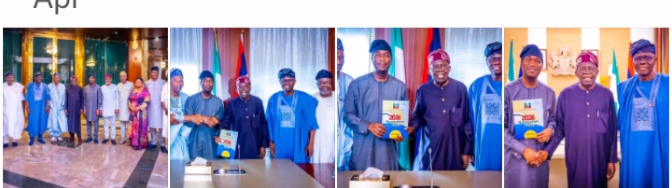
In a move that signals both continuity and calculated transition within Lagos State’s political architecture, President Bola Ahmed Tinubu has formally endorsed Obafemi Hamzat as the All Progressives Congress (APC) consensus candidate for the state’s forthcoming governorship race. The endorsement came during a high-level meeting with members of the influential Lagos Governance Advisory Council (GAC), chaired by Prince Tajudeen Oluyole Olusi, and attended by Governor Babajide Sanwo-Olu.
The meeting, described by insiders as both strategic and symbolic, reflects the enduring weight of party structures in Lagos politics, where consensus-building often precedes electoral contests. The GAC—widely regarded as the backbone of APC’s decision-making machinery in the state—played a central role in aligning stakeholders around Hamzat’s candidacy, reinforcing a tradition of internal cohesion that has long defined the party’s dominance in Lagos.
Obafemi Hamzat, currently serving as Deputy Governor, is no stranger to the intricate workings of governance in Lagos. Known for his technocratic approach and low-profile efficiency, Hamzat has been instrumental in several key policy initiatives under the Sanwo-Olu administration. His emergence as the consensus candidate suggests a deliberate attempt to maintain policy continuity while gradually ushering in a new phase of leadership.
Observers note that President Tinubu’s endorsement carries significant political weight. As the acknowledged architect of modern Lagos politics and a central figure in the APC’s national rise, his support effectively consolidates Hamzat’s position within the party. While the endorsement does not preclude democratic processes, it sends a clear message about the direction of the party’s leadership in the state.
At the heart of this development is the Lagos Governance Advisory Council, a body composed of elder statesmen and key political figures whose influence extends across electoral cycles. Under the leadership of Prince Olusi, the GAC has consistently acted as a stabilizing force, mediating internal disputes and guiding succession planning.
Sources familiar with the meeting indicate that deliberations were thorough, with emphasis placed on experience, loyalty, and administrative competence. Hamzat’s track record, combined with his longstanding association with the party, reportedly made him a unifying choice among council members.
Sanwo-Olu’s Subtle Endorsement
Governor Babajide Sanwo-Olu’s presence at the meeting added another layer of significance. While he has not publicly declared a successor, his alignment with the GAC’s decision is widely interpreted as tacit approval. Throughout his tenure, Sanwo-Olu has maintained a close working relationship with Hamzat, often describing him as a dependable partner in governance.
Political analysts suggest that this alignment helps to minimize internal friction and ensures a smoother transition, a factor that has historically contributed to the APC’s electoral success in Lagos.
The endorsement of Hamzat is likely to reshape the dynamics of the upcoming governorship race. Within the APC, it effectively narrows the field, discouraging potential challengers and reinforcing the party’s tradition of consensus candidacy. Beyond the party, it sets the stage for opposition groups to recalibrate their strategies in response to a candidate backed by both institutional structures and political legacy.
However, questions remain about how this decision will resonate with the broader electorate. While party cohesion is a strength, public sentiment and grassroots engagement will ultimately determine the outcome at the polls.
As Lagos continues to evolve as Nigeria’s economic and cultural hub, the stakes of its governorship remain exceptionally high. The endorsement of Obafemi Hamzat can be seen as part of a broader effort to preserve a governance model that has prioritized infrastructure development, economic growth, and administrative stability.
Whether this strategy will translate into electoral success is yet to be seen. What is clear, however, is that the political machinery behind Lagos governance is once again in motion—carefully calibrated, deeply rooted, and firmly focused on the future.
In the unfolding narrative of Lagos politics, this moment may well mark the beginning of a new chapter—one shaped by continuity, consensus, and the enduring influence of its key architects.
