


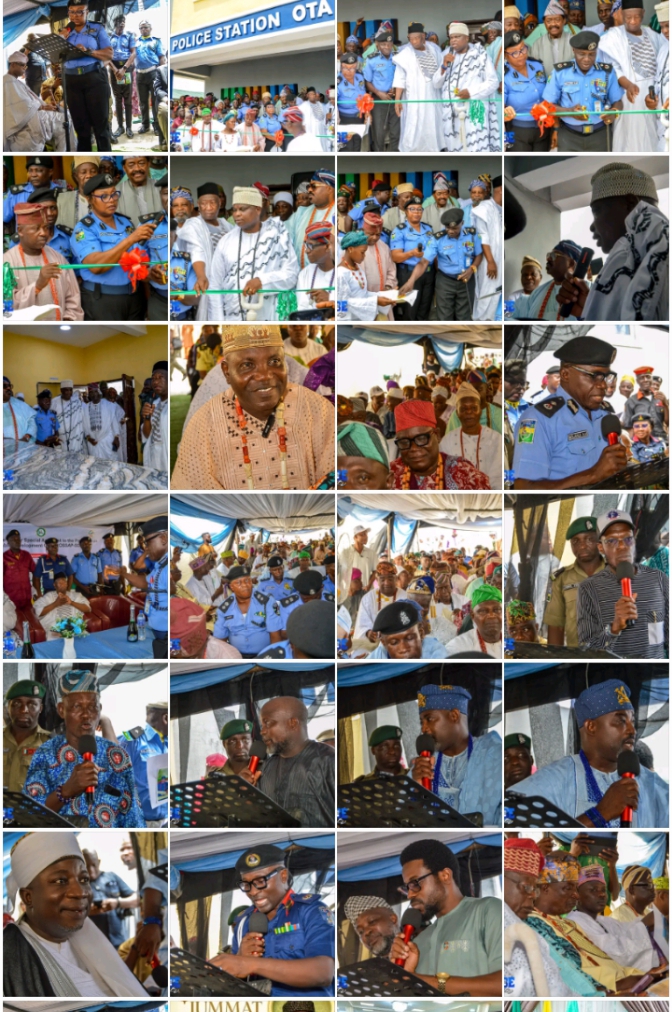
The ancient town of Ota came alive with celebration, pride, and renewed hope on Thursday, May 7, 2026, as dignitaries, security chiefs, traditional rulers, political leaders, and residents gathered at Iganmode Road, Ita Court, for the official commissioning of the newly completed Otta Central Police Divisional Headquarters — a landmark project widely described as a turning point in the town’s security and developmental history.
The modern police facility, strategically located in the heart of the rapidly growing industrial town, was facilitated through the intervention and influence of His Majesty, Professor Adeyemi Obalanlege, the Olota of the Ancient and Paramount Ottaland, Awori Kingdom, while funding and execution were undertaken by the Presidency through the Office of the Senior Special Assistant to the President on Sustainable Development Goals (SDGs), headed by Princess Adejoke Orelope-Adefulire.
The commissioning ceremony was not merely the unveiling of a building; it was the culmination of years of advocacy, leadership engagement, and sustained efforts aimed at strengthening security infrastructure in one of Nigeria’s busiest economic corridors.
For many residents, the project stands as another major achievement under the reign of the Olota, whose leadership has increasingly been associated with development, peacebuilding, institutional collaboration, and infrastructural growth across Aworiland.
Historical records and previous publications on Ota’s traditional institution have consistently highlighted the developmental approach of Professor Obalanlege since his ascension to the throne. Before becoming the Olota, the monarch built a distinguished academic and administrative career, serving as a respected scholar and former Rector of Moshood Abiola Polytechnic. His emergence as Olota marked the beginning of a leadership style that many residents say combines intellectual depth, diplomacy, accessibility, and progressive community engagement.
Over the years, social media posts, community publications, and archival reports have repeatedly documented the monarch’s involvement in peace initiatives, youth development advocacy, educational support programs, cultural preservation, and efforts to attract federal and state government projects to Ota.
Community leaders say the newly commissioned police divisional headquarters is another product of the monarch’s sustained engagement with government institutions and stakeholders on the need to improve security within the industrial town and surrounding communities.
Ota occupies a unique place in Nigeria’s socio-economic landscape. As one of the fastest-growing urban centers in Ogun State, the town hosts major industries, manufacturing companies, markets, educational institutions, and thousands of businesses that contribute significantly to the nation’s economy.
Its strategic proximity to Lagos has also transformed Ota into a major residential and commercial destination for workers, entrepreneurs, and investors. However, with rapid population growth and increasing commercial activities came rising concerns over security challenges, traffic-related incidents, and pressure on existing security infrastructure.
Residents and stakeholders have for years called for stronger security presence and better policing facilities capable of matching the town’s expanding importance. The commissioning of the new divisional headquarters is therefore being viewed as a direct response to those concerns.
Security analysts at the event noted that modern policing infrastructure remains critical to crime prevention, intelligence gathering, rapid emergency response, and community safety, especially within densely populated and commercially active environments such as Ota.
The newly commissioned divisional headquarters is expected to significantly improve police operations within Ota and neighboring communities by providing officers with a more functional and conducive operational environment.
Stakeholders believe the facility will help improve surveillance, strengthen law enforcement visibility, enhance operational coordination, and support efforts aimed at tackling criminal activities within the axis.
Community leaders who addressed journalists during the event expressed optimism that the presence of a modern police headquarters would further promote peace, social stability, and investor confidence in the area.
Many residents also described the project as a morale booster for security personnel serving within the community, noting that improved working conditions would likely translate into better service delivery and stronger engagement between the police and the public.
Special recognition was equally given to the Office of the Senior Special Assistant to the President on Sustainable Development Goals for supporting the execution of the project.
Princess Adejoke Orelope-Adefulire was widely praised for facilitating people-oriented projects across communities through SDG-focused interventions aimed at improving social infrastructure, public welfare, and sustainable development.
Observers at the commissioning ceremony described the collaboration between the Federal Government and the traditional institution as a model worthy of emulation, stressing that grassroots development becomes easier when leadership at different levels works together toward common goals.
The atmosphere surrounding the commissioning reflected more than official protocol; it carried a sense of collective pride among indigenes and residents who believe Ota is entering another phase of accelerated transformation.
Across social media platforms, many residents celebrated the project as evidence of purposeful traditional leadership and responsive governance. Community groups and youth associations described the Olota as a monarch deeply committed to the advancement of his people and the modernization of Aworiland.
Several stakeholders also pointed to the monarch’s previous interventions in conflict resolution, educational advocacy, cultural promotion, and infrastructural development as part of the broader vision that continues to shape Ota’s growth trajectory.
For many observers, the commissioning of the Otta Central Police Divisional Headquarters represents not just the delivery of a security facility, but the strengthening of a collective aspiration for a safer, more peaceful, and more prosperous society.
As celebrations continued across the town following the event, residents expressed confidence that the project would leave a lasting impact on generations to come and further consolidate Ota’s position as one of the most important emerging urban centers in Nigeria.
Indeed, Thursday’s historic commissioning once again underscored the growing influence of visionary traditional leadership in community development and reaffirmed the belief that meaningful progress is achievable when leadership, government, and the people work together for the common good.
