
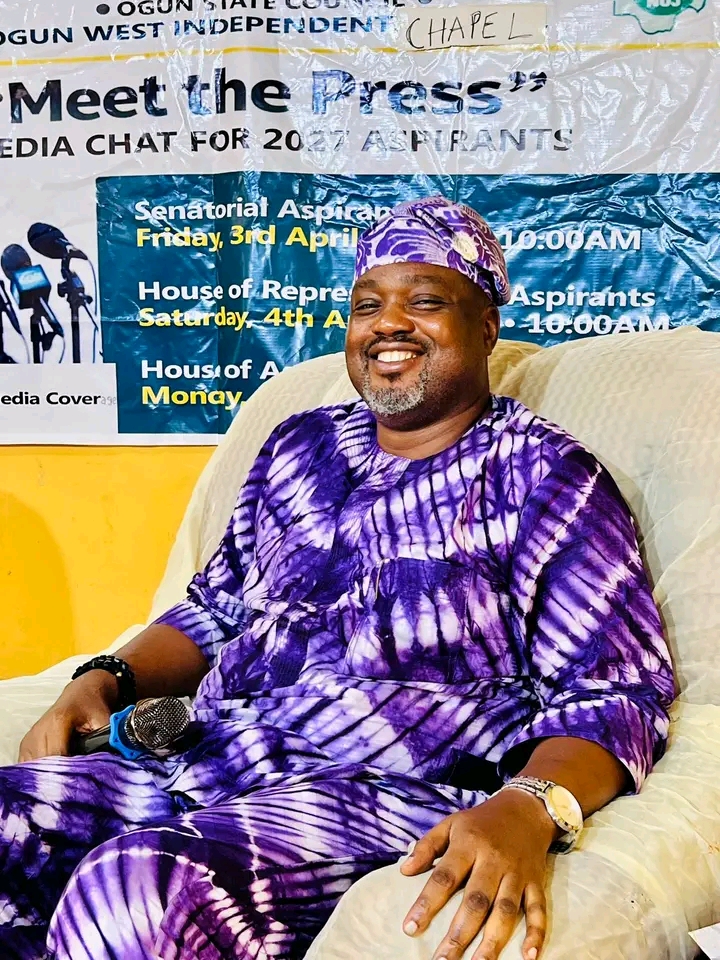
In the unfolding political theatre of Ogun State ahead of the 2027 general elections, one name is steadily commanding attention across both grassroots corridors and elite policy circles—Hon. Sherif Abiodun Yusuf, fondly known as Ibeman. At a time when the stakes for representation, equity, and strategic leadership have never been higher, the Leader of the Ogun State House of Assembly stepped boldly into the spotlight at the Nigeria Union of Journalists (NUJ), Independent Chapel, Ota, under its influential platform, “Meet The Press.”
Held on April 6, the high-profile engagement was far more than a routine media parley—it was a defining political moment. As the first House of Assembly aspirant to mount the platform, Ibeman did not merely present himself; he projected a vision—clear, calculated, and deeply rooted in the aspirations of the people.
From the onset, the atmosphere was charged with anticipation. Journalists, political observers, and stakeholders leaned in as Ibeman navigated a wide spectrum of issues—legislative effectiveness, human capital development, constituency impact, and the delicate interplay between governance and traditional institutions. His responses were not just answers; they were statements of intent—firm, articulate, and grounded in experience.
Yet, the defining moment of the session came when a germane political question was thrown into the arena by Gbenga Fashina, a respected voice and Editor of Yewa Awori News. He probed Ibeman on a matter that has continued to dominate political discourse across the state: the agitation for Ogun West to produce the next governor.
Without hesitation, Ibeman rose to the moment.
With conviction and clarity, he reaffirmed his unwavering stance—declaring that the time for Ogun West is now. Framing his position within the broader context of justice, fairness, and balanced development, he emphasized that the senatorial district, long sidelined in the power equation of the state, deserves its rightful place at the helm of leadership.
But Ibeman did not stop at advocacy—he moved into strategic alignment.
In a bold and unequivocal endorsement, he threw his weight behind Olamilekan Adeola (YAYI), describing him as the most competent, experienced, and politically equipped candidate to actualize the Ogun West governorship ambition. According to Ibeman, YAYI’s track record in governance, legislative impact, and grassroots connection positions him as the bridge between aspiration and actualization.
“Leadership is not just about ambition,” Ibeman noted in essence, “it is about capacity, structure, and the will to deliver—and in YAYI, Ogun West has all three.”
Throughout the session, Ibeman’s political dexterity was unmistakable. On legislative responsibilities, he emphasized people-driven lawmaking and robust oversight as pillars for sustainable development. On human capital, he highlighted strategic investments in youth empowerment, education, and economic inclusion—areas he believes will define the future of Ogun State.
Equally compelling was his recognition of the Awori Traditional Council as a critical partner in governance—an institution he described as indispensable in fostering unity, preserving heritage, and anchoring community-based development.
By the close of the session, one thing was clear: Ibeman had not only engaged the media,he had reshaped the narrative.
Observers left with a renewed sense of his political maturity, strategic depth, and readiness for higher responsibility. More importantly, his outing reinforced a growing consensus within political circles,that the path to Ogun State’s future may very well be charted through the combined force of conviction, collaboration, and a long-awaited power shift to Ogun West.
As the 2027 horizon draws closer, Ibeman is not just participating in the conversation,he is helping to define it.

IBEMAN AT THE FRONTLINES: POWER, EQUITY, AND THE OGUN WEST AGENDA

Related Posts
Add A Comment