


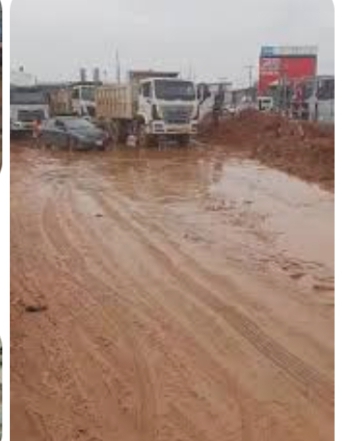
For thousands of residents of Ota and its surrounding communities in Ado-Odo/Ota Local Government Area of Ogun State, every new day begins not with hope, but with the painful uncertainty of how to navigate roads that have become symbols of neglect and hardship.
From the ever-busy Oju Ore axis to the Lafenwa–Itele Road, Obasanjo–Ijagba Road, Ijoko Road, and several adjoining roads, daily commuting has become an exhausting struggle. What should ordinarily be a short journey now consumes hours as motorists, commercial transport operators, traders, workers, artisans, schoolchildren, and the elderly battle deep potholes, muddy stretches, and gridlocked traffic.
Residents say the situation has deteriorated to a humanitarian and economic crisis.
Children leave their homes before dawn yet still arrive late for school. Many parents now spend a significant portion of their earnings on transportation. During the rainy season, some pupils simply stay at home because vehicles cannot access their communities.
For traders and small business owners, the consequences are equally devastating. Customers avoid markets and shopping areas because of the terrible road conditions, while suppliers struggle to deliver goods. Many shops now close earlier than usual, and some have shut down completely as businesses continue to record huge losses.
Artisans—including mechanics, carpenters, welders, tailors, and other skilled workers—lament that clients can no longer reach them with ease, leaving many families without stable incomes.
Commercial transport operators have also been forced to increase fares as vehicles suffer constant damage. Motorcycle (Okada) and tricycle (Keke Napep) operators now charge significantly higher fares, placing additional financial burdens on already struggling residents.
Although construction is ongoing on sections of the Ota-Idiroko Road around Oju Ore, many residents have expressed concern over what they describe as the slow pace of work, urging both the contractor and the supervising authorities to accelerate the project. Recent media reports have also highlighted similar concerns by residents and motorists over delays and the hardship caused by the ongoing construction.
The people are not asking for luxury. They are asking for roads that are safe, motorable, and capable of supporting economic activities in one of Ogun State’s busiest industrial corridors.
Ota is home to numerous industries, educational institutions, and thousands of workers who contribute immensely to the economy of Ogun State and Nigeria. Yet, the deplorable state of its road network continues to undermine productivity, discourage investment, and reduce the quality of life of residents.
This is therefore a passionate appeal to the Federal Government, the Ogun State Government, the Federal Ministry of Works, and all relevant agencies to urgently intervene. The contractor handling the Oju Ore road project should be provided with every necessary support to expedite the work while maintaining high construction standards.
The rehabilitation of the Lafenwa–Itele Road, Obasanjo–Ijagba Road, Ijoko Road, and other critical roads around Ota should equally receive immediate attention before more businesses collapse and more families are pushed deeper into hardship.
Good roads are more than infrastructure—they are lifelines. They connect children to schools, farmers to markets, workers to their jobs, patients to hospitals, and businesses to opportunities.
The people of Ota have endured enough.
Their cry is simple, heartfelt, and urgent: Save Ota. Fix our roads. Restore hope.
