

By all indications, the battle to secure Nigeria’s porous land borders is entering a new phase—one that leans not only on enforcement but on influence, trust, and the enduring authority of traditional institutions.
In the border communities of Ogun State, where footpaths and informal crossings often blur the lines between nations, the Nigeria Customs Service (NCS), Ogun I Area Command, is recalibrating its strategy. The Service is not just deploying officers and surveillance tools; it is actively enlisting the cooperation of those who command grassroots legitimacy—traditional rulers.
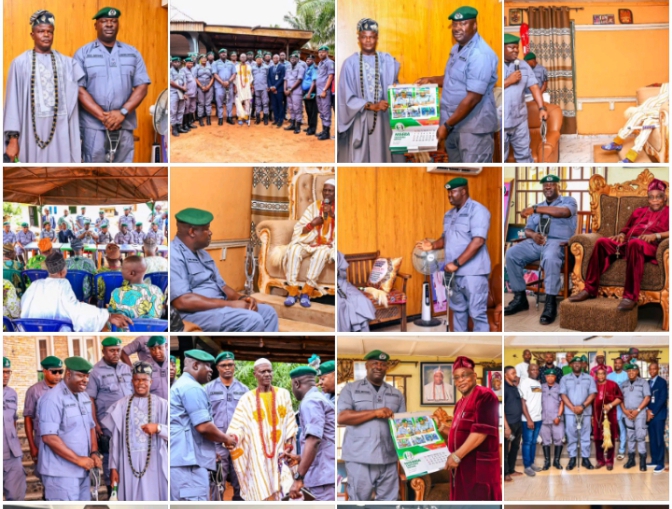
On Wednesday, April 22, 2026, this strategy took center stage as the Acting Customs Area Controller, Deputy Comptroller of Customs Oladapo Afeni, led a high-level delegation on a courtesy visit to the Paramount Ruler of Yewaland, His Royal Majesty, Oba Kehinde Olugbenle, at his palace in Ilaro.
The visit, according to a statement by the Command’s Public Relations Officer, Deputy Superintendent of Customs Chado Zakari, was far from ceremonial. It was a calculated move to deepen collaboration with communities that sit at the frontline of Nigeria’s border security challenges.
Borderlands Under Pressure
Ogun State occupies a sensitive position along Nigeria’s southwestern corridor, sharing boundaries with the Republic of Benin. For decades, this geography has made it both a gateway for legitimate trade and a vulnerable channel for illicit activities—ranging from smuggling of goods to the trafficking of small arms, light weapons, and narcotics.
Afeni, speaking during the engagement, underscored the urgency of the situation. He described Yewaland as a “strategic security partner,” noting that its proximity to international borders places it at the heart of efforts to prevent destabilizing elements from gaining access into the country.
“Our borders must not become gateways for elements seeking to undermine national stability, particularly at a time when democratic processes must be protected,” he said. “We are strengthening surveillance and enforcement mechanisms to ensure criminal networks do not exploit these routes.”
What distinguishes the Command’s current approach is its recognition that enforcement alone cannot solve the problem. In many border communities, traditional rulers wield significant influence over local populations—often more than formal state structures.
By engaging these institutions, the Customs Service is tapping into a network capable of shaping behavior, gathering intelligence, and fostering collective responsibility.
As part of its intensified operations, the Command has rolled out a suite of proactive measures. These include round-the-clock surveillance of identified smuggling corridors, tighter inspection protocols for transit goods, and the creation of direct communication channels with community leaders to enhance intelligence sharing.
The emphasis, officials say, is on early detection and prevention rather than reactive enforcement.
For Oba Kehinde Olugbenle, the initiative aligns with the traditional institution’s long-standing role as custodian of peace and order within the community.
Responding to the Customs delegation, the monarch commended the Service for its forward-looking approach and pledged the support of the Yewa people in safeguarding the region.
He highlighted the critical role of traditional leadership in community sensitisation, particularly among young people who are often most vulnerable to recruitment into smuggling networks.
“Our responsibility goes beyond cultural leadership,” the monarch noted. “We must guide our people—especially the youth—away from activities that threaten peace and national security.”
The outreach did not end in Ilaro. The Customs delegation extended its consultations to other key traditional rulers across the border axis, including the Onihumbe of Ohumbe, Oba Adekola Oje Oladokun, and the Olu of Owode, Oba Mathew Akindele.
At each stop, the message remained consistent: border security is a shared responsibility.
Afeni reiterated that while the Nigeria Customs Service remains committed to facilitating legitimate trade—a crucial component of economic growth—it will maintain a zero-tolerance stance on smuggling and other illegal cross-border activities.
The timing of these engagements is also significant. With Nigeria’s democratic processes always susceptible to external and internal threats, authorities are increasingly wary of the role unsecured borders can play in undermining electoral integrity.
Illegal arms flows, in particular, pose a serious risk, making community-level vigilance an essential layer of national security architecture.
By forging alliances with traditional rulers, the Ogun I Area Command is effectively building a decentralized security network—one that blends formal enforcement with local knowledge and influence.
As Nigeria continues to grapple with the complexities of border management, the Ogun initiative may offer a template for other regions facing similar challenges.
It is a reminder that in a country where tradition and modern governance coexist, sustainable security solutions often lie at their intersection.
For now, in the quiet border towns of Ogun State, a new kind of partnership is taking shape—one where royal authority and state power converge in a shared mission: to keep the nation’s gateways secure.

Customs Tightens the Net at Ogun Borders, Courts Traditional Power to Secure Nigeria’s Frontiers

Related Posts
Add A Comment